Lake Superior Mystery Rocks & Gemstones
In my Lake Superior Rock and Agate identification pages, I offered pictures of a number of rocks I had trouble identifying. Here is a re-post of that section:
Mystery Rocks
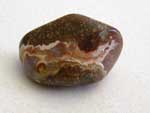
Here's a few that I have yet to narrow down. You can't see it in the photo, but rock A has tiny flecks of sparkly crystals throughout. Rock G. might be Jasper? Rock N has a texture somewhat like sandstone but it seems too solid, heavier than the sandstone I know. Likewise Rocks C & H appear to have sedimentary layers as if they were sandstone or limestone, yet again each has a more solid rock feel/hardness that I don't associate with sedimentary rocks. Rock K. may be slate, yet it is more rounded and pebble shaped than what I gather you'd find in slate. If Rock M was solid, I'd guess Jasper but I haven't found in my reading that quartz veins can be imbedded within Jasper as they do in this sample. Further reading and inspection have caused me to question if the greenish stones labeled "epidote" are correct?
If you have an idea on any of these mystery samples, please drop me a line. roscoetrails@gmail.com
|
|
|
|
Recently I've had some help with my mystery rocks. Melissa Bautz, a geologist in Wyoming who formerly lived in the Upper Peninsula, wrote me her speculations from looking at the rock pictures and reading my descriptions. She prefaced her guesses with the caveat that naturally she is greatly handicapped by not being able to touch and see the rocks in person and to be able to split them open for a positive ID. So I offer her guesses below, with enthusiastic appreciation for her long distance insights, for your education and consumption:
Rock A. The sparkly flecks are likely a mica (probably muscovite). Muscovite is found in metamorphic rocks such as schists, as well as igneous rocks, such as granite, and lastly in sedimentary rocks such as a sandstone. My educated guess on this sample is that it's a schist.
Rock B: This looks to be either a fine grained (very dense) red sandstone/siltstone or a jasperized chert of some sort. Only way to know for sure would be to break open your sample and look for a conchoidal fracture. If it breaks in a conchoidal fracture (I.e. it breaks like glass) then it's jasper. If it doesn't break that way, it's probably another fine-grained red sandstone/siltstone.
Rock C: This looks like it may be a gneiss. The banding in this sample can also be found in sandstones however. The key would be to look at this specimen with a hand-lens and see if you can identify crystals of quartz and felspar and maybe pieces of mica. If there are crystals in the rock (rather than pieces of sand cemented together) then the rock is probably a gneiss.
Rock g: Looks like a jasper to me...as you surmised. The key test here would be to whack open this sample and look for a conchoidal fracture.
Rock h: Hard to tell but this is probably another gneiss.
Rock N: This looks like a textbook granite to me. A so-called pink granite. The pink flecks/crystals are potassium-feldspar (sometimes called "K-spar") crystals. The sparkly flecks are micas (probably muscovite again). And the dull gray parts are probably quartz.
Rock M: Looks like a jasper/chert combo to me. Again, the "acid" test would be to whack it open and see if you get a conchoidal fracture. If you do, the rock is jasper/chert. If you don't, the rock is a sandstone most likely. Or a siltstone. Also, the whiteness could be calcite. As you already know, you can discern between calcite and quartz by hardness.
Rock K: This one is very difficult to discern via a photo. Its darkness and faint banding make me suspect it could be a gneiss. But is could just be a dark sandstone/siltstone with banding as well. Or it could be a banded agate. The test to determine if it is an agate is, of course, to whack in and look for a conchoidal fracture. If you don't want to break it, you may never know what it is!
Regarding your "epidote?" samples. I'd surmise that the green coloration is indeed epidote. The rocks themselves look to be some type of granite perhaps. Again, hard to tell without a fresh "clean surface". But I realize you might not want to sacrifice your samples' beauty just to get an accurate rock ID!
Thanks Melissa . . . Very Educational!
A few postscripts for your edification:
- Melissa makes reference to "conchoidal fracture" Wikipedia defines this as " . . . the way that brittle materials break when they do not follow any natural planes of separation. Materials that break in this way include flint and other fine-grained minerals, as well as most amorphous solids, such as obsidian and other types of glass. "
- In SW Wisconsin, sandstone and limestone is our base rock and is clearly sedimentary. In my Lake Superior rock collecting, I occasionally find specimens, like sample B above, that seem to be sandstone, yet look and feel smoother, somewhat more dense, and lack evidence of sedimentary layers. Recently in my reading of Don Peck's Rock ID pages, I've learned that sedimentary rocks such as sandstone, in certain circumstances, can be subject to the kinds of extreme heat or pressure characteristic of metamorphic rocks. So it will be denser and lack the clear sedimentary appearance charactertistic of sandstone. The next sample I find like this, I'll have to crack it open as Melissa suggests.
~ ~ ~ ~ ~
Jeff King of Pickford, Michigan wrote regarding the Mystery Rock I thought might be epidote. Jeff identifies it as "Unakite" which is composed of quartz, pink feldspar and green epidote. Jeff says "It is found in fair abundance as pebbles & cobble on the shores of Lake Superior and quality pieces are
considered to be semi-precious gems. It is hard and takes an excellent polish and is gaining popularity
in the lapidary world for jewelry and carvings."
Thanks Jeff . . . we'll keep an eye out for those quality pieces for polishing.
~ ~ ~ ~ ~
Anita Mitlying wrote agreeing with Melissa that Rock N could be pink granite and also offered that Rock K could be basalt. I seemed to have lost track of Rock K to look at it again but I do recall it being smooth grained and somewhat polished in appearance. The dark blue band seems not consistent with basalt, suggesting a metamorphic rock that originally was composed of sedimentary layers. Thanks Anita, good luck with your rock collecting.
--Ross - roscoe@superiortrails.com
|